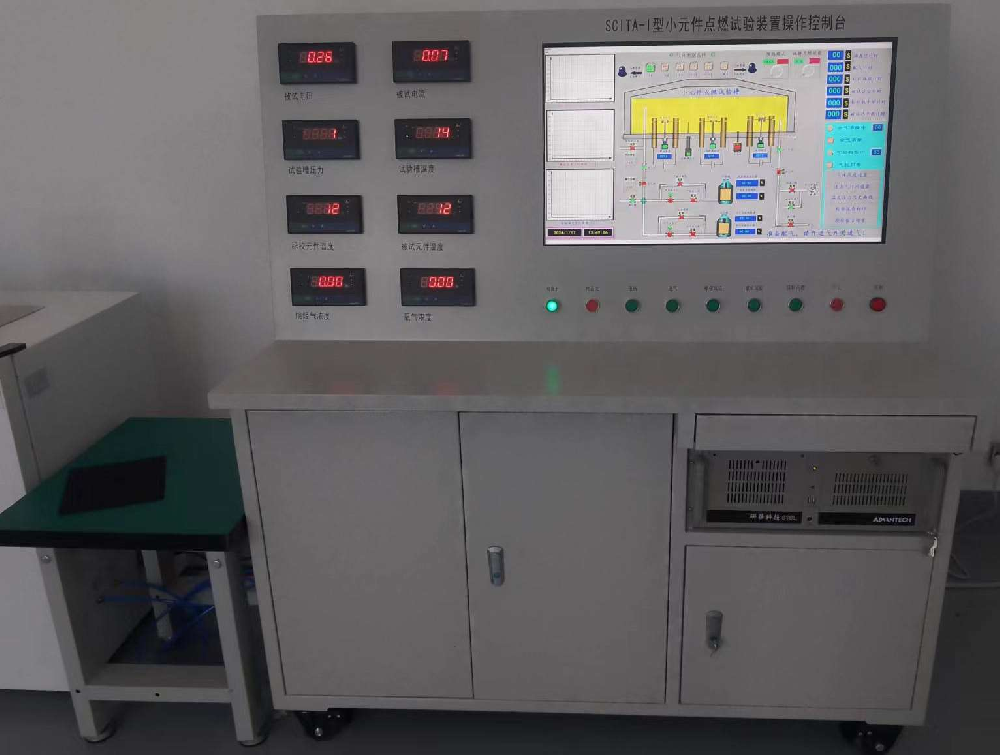
ACG-SCITA-I Small Component Ignition Test Apparatus
Functions and Applications
The SCITA-I Small Component Ignition Test Apparatus is mainly used to evaluate whether small components, including carrier catalytic elements, triodes, field-effect transistors, integrated circuits, quick-acting fuses, solid-state relays, driver ICs, power amplifier ICs, voltage conversion ICs, high-power resistors, switching power supply ICs and reference voltage source ICs, comply with intrinsic safety performance under normal operating or fault conditions.
This apparatus can perform ignition tests on small components of Group I and Group II equipment. It is applicable for intrinsic safety certification bodies to assess the intrinsic safety performance of circuits in products under test, for R&D institutions of explosion-proof instruments to carry out explosion-proof performance verification on product prototypes, for explosion-proof testing centers to conduct safety protection research, and for relevant certification bodies to evaluate the intrinsic safety performance of in-service products or products after maintenance and repair. During each test, gas mixture is prepared in real time, and the concentration of explosive gas inside the test cell is displayed on-screen in real time.
Apparatus Composition
The SCITA-I Small Component Ignition Test Apparatus consists mainly of an operation console and a constant-temperature transparent ignition test cell. On-site auxiliary equipment includes a diethyl ether injector, high-purity methane cylinder and zero-grade air cylinder.
Product Features
1. Adopts PLC programmable control and advanced computer configuration technology to monitor the entire test process in real time; the test sequence and all measured data are displayed on the computer screen.
2. Gas mixture is prepared in real time for every test run with real-time gas concentration readout, delivering high gas concentration accuracy. Fully automatic gas distribution features high preparation precision, short cycle and simple operation.
3. The apparatus automatically purges residual gas after filling the ignition test cell with test gas or after forced ignition of the test gas mixture, eliminating manual gas cleaning operations.
4. Power calculation can be performed for both test and calibration components to judge whether the components are damaged during heating and whether thermal equilibrium is achieved.
5. Gas filling adopts the process of vacuum extraction prior to charging explosive gas mixture. This ensures accurate and stable gas concentration in the test cell, minimizes gas consumption, shortens gas preparation time and achieves remarkable gas savings, creating a safe and eco-friendly laboratory environment.
6. Special sealing measures are implemented for the gas circuit system to guarantee zero leakage. Flame arresting structures are installed on the gas inlet pipelines of the test cell to provide safety isolation against ignition hazards.
7. The apparatus supports printing of test reports or exporting reports as PDF files for storage on the computer. The data is authentic and reliable for later review.
Technical Parameters:
Test cell volume: 750 cm³ | 750 cm³ |
Temperature control range of constant-temperature chamber | Ambient temperature +5 ℃ ~ 300 ℃ |
Effective volume of constant-temperature chamber | 600×500×750 mm (225 L) |
Preheating time of constant-temperature chamber | 20 min (heating up to 40 ℃) |
Temperature control accuracy of constant-temperature chamber | ±1 ℃ |
Gas distribution time of test cell | <120 s (adjustable) |
Gas distribution precision of test cel | ±0.5% |
Maximum withstand pressure of test cell | 1.5 MPa |
Temperature measuring range of component surface temperature sensor | Ambient temperature ~ 1000 ℃ |
| Temperature measuring range of gas temperature sensor | Ambient temperature ~ 200 ℃ |